
October 2026 | The Skinner Team | Anne Skinner, Luxury Mountain Real Estate Expert
TL;DR Is ski-in/ski-out worth it? It can be, when the route to the snow, the rental rules and the carrying costs all check out in Breckenridge, Keystone or Beaver Creek.
Read on before you pay the premium.
"Ski-in/ski-out" may be the most expensive phrase in a Colorado mountain listing, and not every listing that uses it has earned it. Is ski-in/ski-out worth it? For the right buyer in the right building, absolutely. For the wrong one, it is a premium paid for a convenience that never quite shows up. Across Summit County and Eagle County, the difference almost always comes down to three things a listing rarely spells out: the actual route to the snow, the rules for renting it, and what it costs to own.
True ski-in/ski-out means you can ski from the resort to your door, and from your door back to a lift, without getting in a car or crossing a public road. That is the whole definition, and it is stricter than most listing language. Gondola access, "steps to the lift" and a shuttle stop are all useful features, but none of them is ski-in/ski-out, and none of them should be priced like it.
In Breckenridge, most true ski-in/ski-out inventory sits on Peak 7, Peak 8 and Peak 9, along with homes off the Four O'Clock run. Properties near the in-town gondola are usually gondola access, which is a great product in its own right, just a different one at a different price. Shock Hill, for example, has its own stop on the BreckConnect Gondola, which is outstanding access but not ski-in/ski-out: you ride to Peak 7 or Peak 8 rather than skiing to your door.
The route itself is worth walking before an offer. Some ski-backs depend on a trail that only opens midseason, some cross a neighbor's land under an easement, and access that works in a February snowpack can look very different in November. A listing's description is a starting point, not a guarantee.
The ski-in/ski-out premium buys something different at each of the three resorts, and the right choice depends on how you plan to use the home.
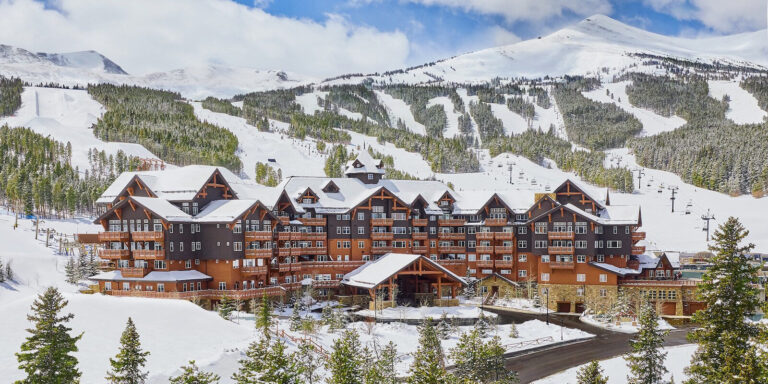
In Breckenridge, true ski-in/ski-out clusters around the bases of Peak 7, Peak 8 and Peak 9 and along the Four O'Clock run, and it spans condos, townhomes and single-family homes. At Peak 7, Crystal Peak Lodge sits at the base of the Independence SuperChair. At Peak 8, One Ski Hill Place is right at the base area, beside the Colorado SuperChair. At Peak 9, Beaver Run Resort and Trails End sit on the slopes, and Peak 9 adds something rare: ski access paired with a short walk to historic Main Street. Along the Four O'Clock run, single-family neighborhoods such as Boulder Ridge let owners ski home at the end of the day.
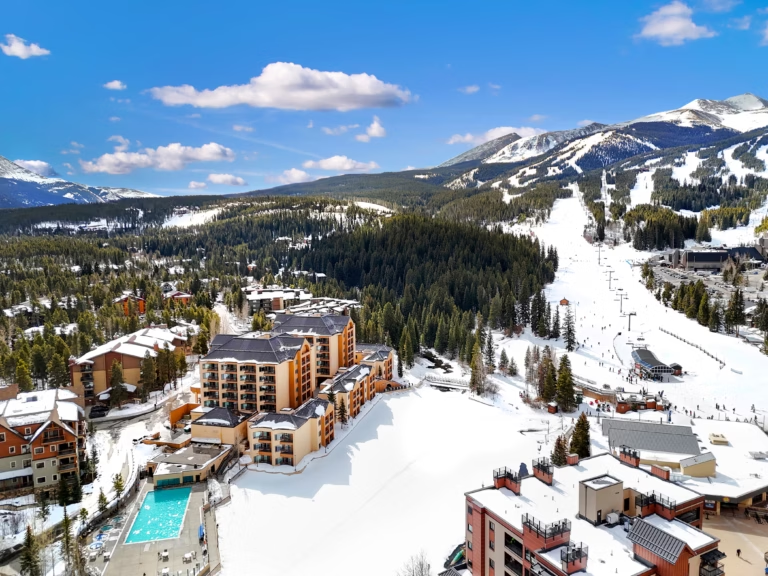
At Keystone, the resort is organized around two base areas, River Run Village and Mountain House, and by the strict definition above there is no true ski-in/ski-out. What Keystone offers instead is ski-access living steps from the lifts. At River Run, Kindred sits closest to the River Run Gondola, with the village's restaurants and shops at the door. At Mountain House, Mountain House Lodge is steps from the base area lifts. It is a village lifestyle rather than a historic downtown, and, as the next sections show, Keystone currently comes with one of the more straightforward rental pictures in the county.
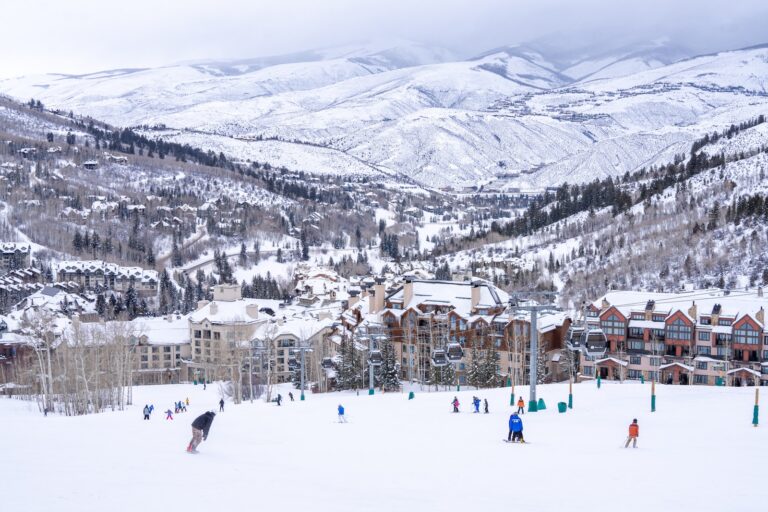
Beaver Creek, in Eagle County just west of Vail, is where true ski-in/ski-out is part of the resort's design. In Beaver Creek Village, buildings such as Borders Lodge sit on the slopes by the Elkhorn Chairlift, and in the Highlands, condos, townhomes and single-family homes sit directly on the runs. Up the mountain, gated Bachelor Gulch and Strawberry Park are built around their own lifts, the Bachelor Gulch Express and Strawberry Park Express. Ski-in/ski-out here is often a large single-family home, and the price per square foot reflects it. Even here, access can hinge on one lift: Elkhorn, for example, can close earlier than the rest of the mountain, which is worth knowing before you rely on it.
→ See what's available on the slopes now: browse luxury ski homes for sale across Summit County and the Vail Valley.
There is no widely published ski-in/ski-out premium for Summit or Eagle County. The percentages that circulate online come from other resort markets: reports out of Whistler and Lake Tahoe put the premium somewhere between roughly 15 and 40 percent. Those markets have different inventory, rental rules and building stock, so their numbers don't translate directly to Breckenridge or Beaver Creek.
The more useful comparison is building by building: a specific property against the closest similar sales nearby that are not ski-in/ski-out. The gap moves with a handful of factors:
That last factor deserves its own section, because it changes the value of a ski-in/ski-out home more than most buyers expect.
If rental income is part of the plan, the rules matter as much as the location, and they differ in every jurisdiction.
Breckenridge divides short-term rentals into four zones: the Resort Zone, Zone 1 (tourism), Zone 2 (the downtown core) and Zone 3 (residential). The Resort Zone, where many of the large ski-in/ski-out buildings sit, has no license cap. Zone 1 has had licenses available, while Zone 2 and Zone 3 are at or over their caps with waitlists. The detail that surprises many buyers: according to the Town of Breckenridge, short-term rental licenses are non-transferable and are relinquished when a property sells. The new owner applies fresh, under whatever rules apply that day.
Keystone took over short-term rental licensing from Summit County in 2024. The Town of Keystone states there are no caps on the number of licenses at this time, and a license costs $285 a year. Town licensing does not override an HOA's own rental restrictions.
Beaver Creek works differently. It is a private resort community managed by the Beaver Creek Resort Company in unincorporated Eagle County, with no rental zones and no publicly stated license cap. Owners who rent more than four days in a month need a Beaver Creek Lodging Business License and pay civic and lodging assessments.
Elsewhere in Summit County, Copper Mountain sits in the county's Resort Overlay Zone, which has no license cap, while the county's neighborhood basins are capped with waitlists, and Blue River has paused new short-term rental licenses through at least the end of 2026. Rules change, so it pays to confirm the zone and the HOA's rules for the specific building before writing an offer, and to get rental projections from a local property manager rather than from a listing.
Rental eligibility also shapes value and resale. True ski-in/ski-out tends to sit where short-term rentals are easiest to license: Breckenridge's Resort Zone, the county's Resort Overlay Zone at Four O'Clock and Copper Mountain, and Beaver Creek, where there is no license cap. That is part of what the premium buys, and part of why these homes appeal to two groups of buyers: those who will use the home part-time and rent it the rest of the year, and those who never plan to rent at all. A home that can't be rented gives up the first group.
→ Compare short-term rental rules by town: see our Summit County and Beaver Creek short-term rental guide.
Slopeside buildings come with pools, heated walkways, ski lockers and sometimes a ski valet. Every one of those amenities is paid for through HOA dues, along with staffing, maintenance and the building's master insurance policy. Two buildings at similar prices can carry very different dues, and dues change as those costs change, so the current monthly number is only part of the picture.
Before buying a ski-in/ski-out home, ask for four documents:
If a building cannot or will not produce them, that is the answer.
Generally, yes. True ski-in/ski-out is a limited resource: slopeside land is scarce, the resorts are not making more of it, and it remains some of the most sought-after property in the mountains. In our experience, that combination of scarcity and desirability has helped these homes appreciate faster than comparable properties farther from the lifts.
Location is not the only thing that drives value, though. Like any property, a ski-in/ski-out home is only as strong as its building or neighborhood, and no one can guarantee what any home will be worth later. Before judging a specific property, look at how homes in the same building or neighborhood have actually sold, and how long they took, so the decision rests on local evidence rather than a general rule.
→ See how the market is moving: review the latest Summit County market reports.
Ski-in/ski-out earns its premium for buyers who will ski a lot of days, who do not want to haul gear to a shuttle, and for owners whose building sits where short-term rental is allowed and renting is part of their plan.
It is harder to justify for buyers who will visit a few weekends a year, who love summer as much as winter, or who would rather have more space and a view. For them, a home in Frisco, Dillon or Silverthorne, a short drive from several resorts, often delivers more of what they actually use.
Ski-in/ski-out is worth the premium when three things line up: the access is real, the rental rules fit the way you plan to own, and the building's finances hold up. Miss any one of them and the premium buys less than it appears to.
Before writing an offer in Breckenridge, Keystone or Beaver Creek, walk the route in early-season conditions, confirm the rental zone and HOA rules for the specific building, and read the HOA budget, reserve study and insurance history. With those answers in hand, the decision stops being about a phrase in a listing and becomes about one building, and whether it fits the way you will actually use it.
Ski-in/ski-out in Breckenridge is worth the premium for buyers who ski often, host guests, or plan to rent in a zone that allows it. Most true ski-in/ski-out sits on Peak 7, Peak 8, Peak 9 and off the Four O'Clock run. Before paying the premium, confirm the actual route to the snow, the property's short-term rental zone, and the HOA's budget, reserves and insurance history.
At $2M and above, ski-in/ski-out is worth it when the home will be used heavily in winter and the building holds up to scrutiny. At that price point, the decision turns less on convenience and more on the specific building: whether the access is truly door-to-snow, whether the rental rules fit the ownership plan, and whether HOA reserves and insurance are stable. Buyers who mainly visit in summer often get more value from a larger home in Frisco, Dillon or Silverthorne, a short drive from the lifts.
Generally, yes. Because true slopeside land is limited and in high demand, ski-in/ski-out homes in Summit and Eagle Counties have tended to appreciate faster than comparable homes farther from the lifts. Location is not the only factor, though, and no one can guarantee future value; the best guide to a specific property is how homes in the same building or neighborhood have sold and how long they took.
Ski-in/ski-out means you can ski from the resort to your door and from your door back to a lift without driving or crossing a public road. Gondola access, a short walk to a lift, or a shuttle stop are convenient, but they are not true ski-in/ski-out and should not carry the same premium.
Often, yes, but it depends on the exact property. In Breckenridge, the Resort Zone has no license cap, while Zones 2 and 3 are capped with waitlists, and licenses do not transfer when a property sells. In Keystone, the town currently has no cap on short-term rental licenses, which cost $285 a year. In both towns, the HOA can still restrict rentals.
The largest hidden cost is usually the HOA, which pays for slopeside amenities such as pools, heated walkways and ski lockers, along with the building's insurance. Dues vary widely between buildings and change as costs change. Ask for the HOA budget, reserve study, insurance renewal history and any planned special assessments before buying.
There is no reliable published figure for the ski-in/ski-out premium in Summit or Eagle County. Percentages quoted online typically come from other resort markets. The useful number is building-specific: compare the property against the closest similar sales nearby that are not ski-in/ski-out, accounting for access, property type, age, amenities and rental rules.
Considering a ski-in/ski-out home? Ask The Skinner Team for a building check: we will walk the route to the snow, confirm the rental rules and pull the HOA budget and insurance history before you make an offer.
→ Find out what your mountain home is worth
→ Schedule a conversation with The Skinner Team
Or call The Skinner Team at 970-389-6987 and visit CoMtnRealty.com.
About the author
Anne Skinner is the founder of The Skinner Team at Keller Williams Top of the Rockies, with more than 12 years of experience in Colorado mountain real estate across Summit County, Vail and Beaver Creek. She holds the Resort and Second-Home Property Specialist (RSPS), Certified Negotiations Expert (CNE) and Summit Area Specialist (SAS) designations. Learn more about Anne




Disclaimer: All information contained in this web site is deemed reliable but not guaranteed. All properties are subject to prior sale, change or withdrawal notice. COMtnRealty.com believes all information to be correct but assumes no legal responsibility for accuracy.


