April 2026 | Colorado Mountain Realty | Anne Skinner, Summit County Real Estate Expert
TL;DR
The right eco-friendly upgrades reduce operating costs, protect your investment, and matter to luxury buyers. Colorado also offers specific incentive programs most homeowners don’t know about.
Read on for a prioritized, Summit County-specific guide.
Owning a home in Summit County is a different kind of responsibility.
The landscape surrounding Breckenridge, Frisco, Keystone, Dillon, and Silverthorne is not incidental to why people buy here. It is the reason. The Gore Range, the Blue River corridor, the spruce and aspen forests, the alpine meadows: these are what give Summit County properties their meaning and their value. For most owners, especially those who have invested in this market at a serious level, responsible stewardship of that environment is not a checkbox. It is an extension of why they are here.
Sustainability in a mountain home is also a practical and financial discipline. High altitude, extreme cold, intense UV radiation, and dramatic seasonal swings create conditions where energy efficiency and material durability are not optional considerations. They are the difference between a home that performs well year-round and one that costs far more to operate and maintain than it should.
This guide addresses both dimensions: the environmental stewardship that mountain homeownership calls for, and the strategic upgrades that protect and grow the value of a Summit County property over time.
Why Sustainability Is Different at High Altitude
The conditions that make Summit County extraordinary also make it demanding on the homes built here. Understanding those conditions is the starting point for any intelligent sustainability strategy.
Extreme thermal demands. Summit County’s elevation means temperatures regularly drop well below zero in winter, and heating seasons are substantially longer than at Front Range elevations. A home that is not properly insulated and air-sealed is not just inefficient. It is fighting the environment constantly.
Exceptional solar resource. The National Renewable Energy Laboratory (nrel.gov), headquartered in Golden, Colorado, has documented that higher elevations receive stronger solar radiation than lower altitudes, making Summit County one of the more favorable solar environments in the state.
Material exposure. UV intensity at 9,000 to 10,000 feet degrades materials faster than at lower elevations. Roofing, siding, decking, and window seals all face accelerated wear. Sustainable material choices are also, in this environment, the most durable and cost-effective ones.
Water scarcity. Colorado’s water resources are finite and carefully managed. Summit County sits at the headwaters of watersheds that serve communities well beyond the mountains. Homeowners here have a direct role in that stewardship, and local organizations like High Country Conservation (highcountryconservation.org) actively support homeowners in Summit and Eagle counties who want to make meaningful, informed choices about water and resource use.
Energy Efficiency: The Foundation of Every Smart Mountain Home
Before any renewable energy investment makes sense, the home itself needs to be tight. Heat loss through air leaks, inadequate insulation, and underperforming windows and doors is the single largest source of energy waste in mountain homes, and the most cost-effective place to start.
Insulation and Air Sealing
The U.S. Department of Energy (energy.gov/energysaver) identifies proper insulation and air sealing among the highest-return energy investments a homeowner can make, particularly in cold climates like Summit County. For mountain homes, this means evaluating attic insulation levels, crawl space vapor barriers, rim joist sealing, and window and door weatherstripping. A professional energy audit identifies exactly where a home is losing heat and prioritizes improvements by cost-to-return ratio.
Windows and Doors
In a luxury mountain home, windows are not just an energy feature. They are a primary design element. Floor-to-ceiling glass capturing Gore Range views or sunrise over the Ten Mile Range is what many buyers remember long after the showing. The best high-performance windows now achieve this without thermal compromise: triple-pane glass, thermally broken frames, and low-e coatings designed specifically for high-altitude UV exposure deliver both exceptional views and meaningful energy performance. ENERGY STAR-rated window products (energystar.gov) provide a reliable baseline for evaluating performance.
Smart Home Energy Management
For second-home owners, which represents a significant portion of Summit County’s luxury market, smart thermostats and remote energy management systems are among the highest-value upgrades available. The ability to manage heating remotely, set occupancy schedules, and monitor energy use in real time reduces waste significantly in homes that may sit unoccupied for extended periods. Systems like Ecobee and Nest are now standard expectations among luxury buyers in resort markets.
Heating Systems Built for Mountain Performance
Heating is the dominant operating expense in a Summit County home. It is also the area where the right upgrade decision has the most meaningful impact on comfort, on operating costs, and on the long-term value of the property.
Radiant Floor Heating
In the luxury mountain home segment, radiant floor heating has become less of a premium feature and more of an expectation. Hydronic radiant systems, which circulate heated water through tubing embedded in the floor, deliver even, consistent warmth from the ground up, eliminate the air quality issues associated with forced-air systems, and operate quietly. For a home where a buyer is imagining waking up and walking barefoot to the kitchen at 9,600 feet in February, radiant heat is not an amenity. It is a core part of the lifestyle proposition.
Cold-Climate Heat Pumps
Cold-climate heat pump technology has advanced significantly in recent years, with modern systems now operating efficiently at temperatures as low as -15 degrees Fahrenheit, well within the range of Summit County winters. When paired with a high-efficiency backup heat source, a cold-climate heat pump provides substantial energy savings while reducing a home’s carbon footprint. Colorado’s largest utility provider, Xcel Energy, currently offers rebate programs for qualifying heat pump installations (xcelenergy.com), a meaningful financial incentive worth investigating before committing to a heating system upgrade.
Wood and Pellet Stoves
A well-designed fireplace or wood stove is one of the defining features of a mountain home, and in many Summit County properties it serves a dual role as both a design centerpiece and a meaningful supplemental heat source. High-efficiency EPA-certified wood and pellet stoves generate significant heat output with dramatically lower particulate emissions than older models. In a market where buyers are making an emotional purchase as much as a financial one, the experience of gathering around a wood-burning fireplace during a snowstorm carries weight that no data point can fully capture.
Solar Power at Elevation: A Strong Case for Summit County
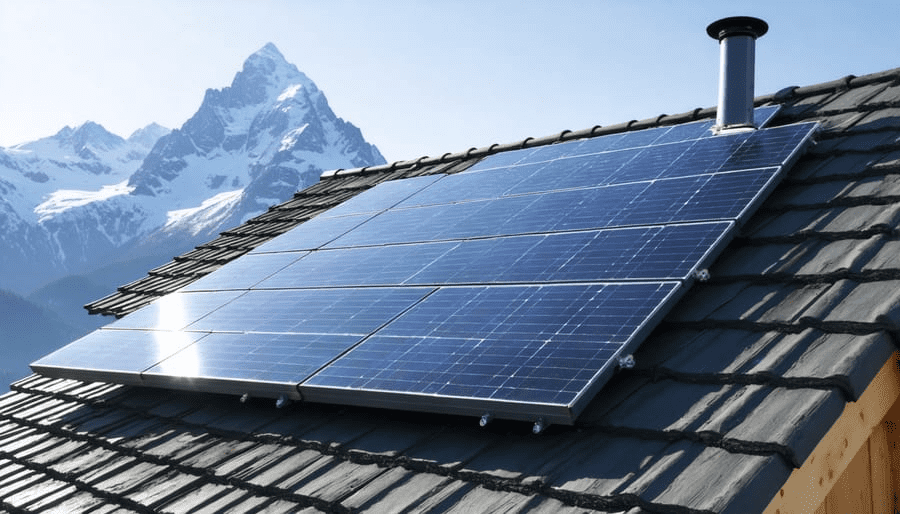
Summit County’s solar resource is genuinely compelling. Despite the perception that a mountain environment means overcast skies, the reality is that Colorado is one of the sunniest states in the country, and high elevation amplifies that advantage. The thinner atmosphere at altitude means solar panels receive stronger radiation than equivalent systems at lower elevations, a factor documented extensively by the National Renewable Energy Laboratory in Golden, Colorado.
For a second home that may sit unoccupied for weeks at a time, a well-designed solar system can offset the baseline energy consumption of heating, smart home systems, and security monitoring, reducing both costs and the carbon footprint of a property that is not being actively used.
Colorado Incentives and Rebates
Colorado homeowners considering solar have access to a meaningful stack of financial incentives that significantly reduce the net cost of installation. The federal Investment Tax Credit currently provides a 30% tax credit on solar installation costs. The Colorado Energy Office (energyoffice.colorado.gov) administers additional state-level programs, and Xcel Energy offers Solar*Rewards incentives for qualifying installations in its service territory. Before any solar decision, a Colorado-licensed installer familiar with Summit County’s specific conditions, including roof pitch, snow load, shading, and net metering terms, should conduct a site-specific assessment.
Water Conservation: A Responsibility That Comes with Mountain Ownership
Colorado’s water is not merely a utility. It is a resource managed under a complex system of water rights that reflects the scarcity and value of water in the Mountain West. Summit County sits at the headwaters of watersheds that supply communities throughout Colorado and beyond. Responsible water use is not an abstract environmental principle for Summit County homeowners. It is a direct expression of stewardship for a landscape that is the reason this community exists.
High Country Conservation (highcountryconservation.org) is the local resource Summit County homeowners should know. This Summit and Eagle County organization works directly with residents and property owners on water conservation, energy efficiency, and sustainable land stewardship, providing guidance and resources that are specific to the high-country environment rather than generalized advice built for lower elevations.
Inside the Home
• EPA WaterSense-certified fixtures (epa.gov/watersense) for faucets, showerheads, and toilets deliver full performance at measurably lower water consumption, with no compromise in the luxury experience
• High-efficiency dishwashers and washing machines carrying the ENERGY STAR certification for water use
• Hot water recirculation systems that eliminate extended wait times common in larger mountain homes, reducing both water waste and the frustration of waiting for a hot shower after a day on the mountain
Outside the Home
• Native and drought-adapted plantings that thrive in Summit County’s climate without supplemental irrigation. Colorado Blue Spruce, native willows, and high-altitude wildflower meadows create a landscape that feels of the place rather than imposed on it
• Permeable paving materials for driveways and walkways that allow snowmelt and rainfall to recharge groundwater rather than run off
• Thoughtful drainage design that preserves the natural terrain and prevents erosion through the freeze-thaw cycles that Summit County experiences each spring and fall
Sustainable Materials: Built to Last at Altitude
In a mountain environment, sustainable materials and durable materials are often the same thing. The most responsible choices are frequently those that also perform best under Summit County’s demanding conditions, and they often define the aesthetic character of the finest mountain homes.
Exterior
• Standing seam metal roofing: the standard for serious mountain homes, with a lifespan measured in decades, exceptional snow-shedding performance, and strong recyclability at end of life
• Fiber cement siding such as Hardie board: dimensionally stable through freeze-thaw cycles, resistant to moisture intrusion, and available in profiles that complement the mountain modern aesthetic defining the best contemporary Summit County architecture
• Locally sourced Colorado stone: quarried from the surrounding region with a minimal transportation footprint, and a visual connection to the landscape that no imported material can replicate
Interior
• Reclaimed wood beams, flooring, and millwork: the most environmentally responsible timber choice and often the most visually compelling. The character and patina of reclaimed wood carries a story that new materials simply cannot offer
• Low-VOC paints and finishes: particularly important at high altitude where ventilation is managed carefully and indoor air quality is a meaningful wellness consideration
• FSC-certified lumber for any new construction or addition work, ensuring that the timber used in your home comes from responsibly managed forests
The U.S. Green Building Council’s LEED framework (usgbc.org) provides a rigorous, third-party validated standard for sustainable building practices that is increasingly relevant in the luxury mountain home market. LEED certification or equivalent green building documentation can meaningfully differentiate a property for environmentally conscious buyers.
What Luxury Buyers in Summit County Are Looking For
The luxury buyer profile in Summit County has shifted meaningfully over the past decade. Environmental values are no longer a niche preference. They are an increasingly mainstream expectation among buyers in the $1.5M to $5M+ range. This shift is not purely ideological. Buyers at this level are sophisticated enough to understand that a well-built, energy-efficient home with durable materials and lower operating costs is simply a better asset.
Properties that demonstrate a genuine commitment to sustainable design, not as a marketing add-on but as an integrated part of how the home was built and maintained, command attention from this buyer. The ability to articulate specific upgrades, their performance characteristics, and their financial impact, including reduced utility costs, extended material lifespan, and applicable incentives, is part of how a luxury listing in this market earns and sustains a premium position.
→ Explore Summit County’s spring market conditions and what buyers are prioritizing right now: comtnrealty.com/market-reports
When to Make Eco-Friendly Upgrades: A Strategic Framework
The timing of sustainable upgrades depends on where you are in your ownership journey and what you are trying to accomplish.
Preparing to sell: Focus on upgrades that are visible and documentable. Smart thermostats, new windows, updated heating systems, and any existing solar infrastructure are the improvements a buyer’s agent will highlight and that appear in a professional marketing package. Cosmetic sustainability touches are worth doing for staging purposes but should not be the primary investment if budget is limited.
Planning to stay long-term: Prioritize improvements with the longest payback horizon and the greatest impact on daily comfort. Insulation, heating system optimization, radiant floor heating in key living areas, and solar all return value over years and decades, and they meaningfully change the experience of living in a mountain home.
Recently purchased: Begin with a professional energy audit to establish a baseline and identify priorities. Summit County’s conditions make energy performance highly variable from property to property. A home at 10,000 feet faces different demands than one at 8,500 feet, and a north-facing property has different solar potential than a south-facing one. An audit provides the data to make decisions confidently. High Country Conservation (highcountryconservation.org) is also a valuable local starting point for new owners navigating these decisions.
→ For a deeper understanding of how market timing intersects with property improvements, see our guide to Summit County Real Estate Market Seasonality
Frequently Asked Questions
What are the highest-impact eco-friendly upgrades for a mountain home in Summit County?
In order of long-term impact: insulation and air sealing, high-performance windows and doors, a high-efficiency heating system (radiant or heat pump), smart energy management, and solar. These five areas address the highest sources of energy waste and operating cost in a Summit County home. For sellers, smart thermostats, new windows, and documented heating upgrades also have the clearest impact on buyer perception and listing value.
Is solar power effective in Summit County, Colorado?
Yes. Summit County’s high elevation and Colorado’s abundant sunshine create favorable solar conditions year-round. The National Renewable Energy Laboratory has documented that higher elevations receive stronger solar radiation due to the thinner atmosphere. Colorado’s 30% federal Investment Tax Credit, Xcel Energy Solar*Rewards incentives, and Colorado Energy Office programs can significantly reduce the net cost of installation. A site-specific assessment by a qualified Colorado installer is the right first step.
Do sustainable upgrades increase resale value in Summit County’s luxury market?
Yes, with important nuance. The most impactful upgrades for resale are those that are visible, documentable, and directly connected to buyer concerns: lower operating costs, comfort in extreme cold, and durable materials that reduce maintenance burden. High-efficiency heating systems, quality windows, smart home energy management, and solar installations are the upgrades most likely to be reflected in buyer offers.
What building materials perform best in Summit County’s mountain climate?
Standing seam metal roofing, fiber cement siding, locally sourced Colorado stone, and triple-pane windows with thermally broken frames are the current benchmarks for high-performance mountain home construction. Reclaimed wood is the preferred interior timber choice for both sustainability and aesthetic quality. All of these materials share a common characteristic: they are designed for durability under high UV exposure, freeze-thaw cycles, and heavy snow loads.
Are there local resources in Summit County for homeowners interested in sustainability?
Yes. High Country Conservation (highcountryconservation.org) works directly with Summit and Eagle County residents and property owners on water conservation, energy efficiency, and sustainable land stewardship. For financial incentives, the Colorado Energy Office (energyoffice.colorado.gov) and Xcel Energy (xcelenergy.com) both offer programs relevant to mountain homeowners. These resources are specific to Colorado and far more applicable than generic national guides.
Let’s Talk About Your Property’s Position in the Market
Whether you are considering upgrades before listing, evaluating a recently purchased property, or simply want to understand how sustainable improvements affect value in today’s Summit County market, our team works through these decisions with clients regularly. Every property is different. The right conversation starts with understanding yours.
Request Your Complimentary Home Valuation →
Schedule a Conversation with the Colorado Mountain Realty Team →