
Home › Summit County short-term rentals › Unincorporated Summit County
Short answer: It depends on the overlay zone. Homes outside town limits in Summit County's Resort Overlay Zone, such as Copper Mountain, Tiger Run Resort and parts of the base of Peak 8, can get a license with no cap. Everywhere else outside town limits is the Neighborhood Overlay Zone, where investor (Type II) licenses are capped by basin, the county isn't taking new Type II applications and licenses come only from waitlists. Neighborhood-zone rentals are limited to 35 bookings a year. Licenses don't transfer when a home sells.
Enter a property address to see which government licenses it, whether a new owner can get a license today, the fee and the tax on each stay.
Uses Summit County and Town of Breckenridge public map data; license counts as of the dates on this page. Results are a starting point, not a guarantee.
Summit County licenses short-term rentals in every area outside the seven towns. Since December 2021, it has divided those areas into two overlay zones with very different rules:
Copper Mountain, Tiger Run Resort, some undeveloped parts of the Keystone area and unincorporated areas at the base of Peak 8 in Breckenridge. One license type, no cap and unlimited bookings and nights. $290 a year.
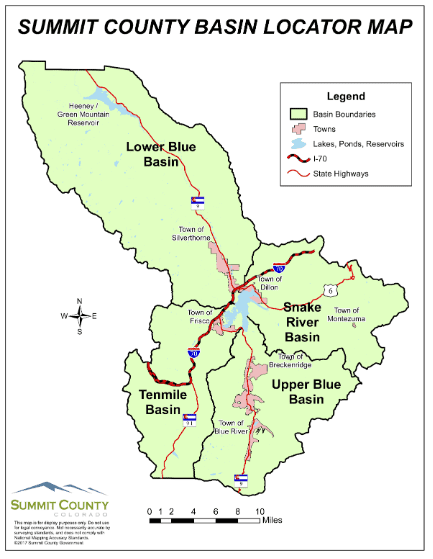
Every other unincorporated area, split into four basins with separate caps on investor (Type II) licenses. Rentals are limited to 35 bookings a year, and new Type II licenses come only from waitlists.
| Basin | Areas near | Type II cap | Count (Jan 2026) | Status |
|---|---|---|---|---|
| Upper Blue | Breckenridge and Blue River, such as Breckenridge Heights, Peak 7, French Gulch and Gold Hill | 590 (18%) | 563 (809 before 2023) | Waitlist 26 issued in 2026 |
| Lower Blue | Silverthorne, such as Wildernest, Mesa Cortina, Hamilton Creek, Ruby Ranch, Ptarmigan and Heeney | 550 (15%) | 508 (712 before 2023) | Waitlist 16 issued in 2025, 41 in 2026 |
| Snake River | Dillon and Keystone, such as Dillon Valley, Summerwood and Summit Cove | 130 (5%) | 137 (257 before 2023) | Over cap none issued yet |
| Ten Mile | Frisco, such as Bills Ranch and Frisco Heights | 20 (6%) | 24 | Over cap |
Source: Summit County short-term rental regulations page; counts are updated by January 5 each year. The county isn't accepting new Type II applications; it notifies waitlist applicants as licenses open up through attrition.
The license a typical second-home owner or investor needs. Up to 35 booking parties a year (October 1 to September 30), with no limit on how long each stay lasts. Capped by basin; new licenses come only from the waitlist. $355 a year.
For homes lived in by a "qualified occupant," the owner or a long-term tenant who meets the county's local residency and employment rules (retirees can qualify). Not counted toward the basin caps, but the same 35-booking limit applies. $235 a year.

Summit County Short-Term Rental Licenses: Where You Can (and Can't) Get One (Anne Skinner, YouTube). Watch on YouTube
Town and county licenses are only half the answer. These HOAs have short-term rental limits we’ve seen or been told about. Always confirm in the current declarations before you buy, because owners can vote to change them.
Deed-restricted workforce housing generally doesn’t allow short-term rentals. "Reported" means we haven’t reviewed the current declarations ourselves. See our full HOA restrictions list for all of Summit County. The address checker above flags these communities when county records match.
Licenses and averages are only part of the picture. Management usually costs 20% to 40% of booking revenue, HOA dues and special assessments add up, and many rentals here don't cover their full costs. Read our honest take on the good, the bad and the ugly of owning a short-term rental in Summit County, and our buying checklist.